
Beyond the Surface: What Is Myofascial Release Therapy?
- Hernan (Orthopaedic Massage)

- 3 days ago
- 3 min read
If you are living with chronic pain, you have likely tried it all. You might have seen highly regarded chiropractors or osteopaths, or sought out deep tissue sports massages. Yet, the ache persists. You talk to your friends and family about it, but there is a distinct exhaustion that comes with carrying a pain that no one else can see.

Often, we look at pain as a sudden glitch in the machine. But your body has had a lifetime of pattern establishment. A lifetime of stresses, accidents, injuries, and traumas are written into your physical form, creating the very issues you are experiencing today. To truly resolve this, we have to look past the muscles and bones and listen to the tissue that holds it all together: your fascia.
Understanding the Clingfilm of the Body
What exactly is fascia? Forget the dense textbook definitions. Imagine the delicate, clingfilmy, velvety structure you see when preparing food in the kitchen. In your body, fascia is the connective tissue that provides your entire structure. It is a brilliant, primitive communication network that transfers loads and forces around your body efficiently.

When your fascia is healthy, it is fluid and resilient. But when life happens—through trauma, repetitive strain, or emotional stress—that velvet network can get snagged. Sometimes, the tissue becomes overstretched in a certain pattern, and it simply cannot bounce back to its original place without manual help. That is where Myofascial Release Therapy (MFR) comes in.
It Is Not an Aggressive Massage—It Is a Dance
One of the biggest misconceptions about Myofascial Release is that it has to be a painful, aggressive, no pain, no gain style of deep tissue massage. It is exactly the opposite. MFR is a slow, profoundly specific type of bodywork—more specific than a traditional massage could ever be. It does not require speed, and it absolutely does not have to cause pain. Instead, it respects the history of your tissue.
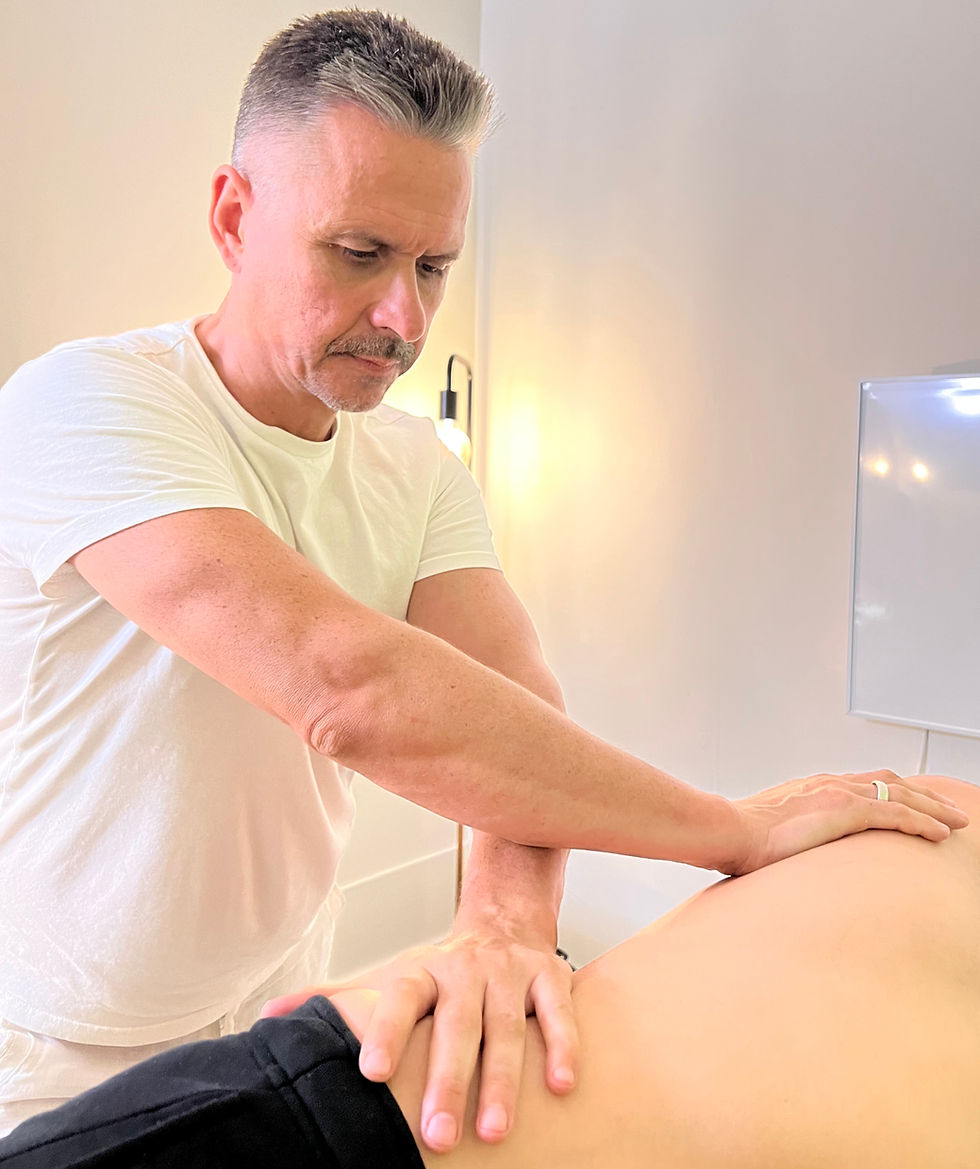
A person in their mid-60s came to my clinic with a persistent shoulder issue that had resisted multiple treatments from high-regard practitioners. When we utilised MFR, the work was gentle and specific, allowing the fascial tissue to bounce back from an overstretched pattern. The patient described the session not as a treatment, but as a dance. They noted that when one stroke is being performed, the next one is already being prepared, allowing the body to prepare the next dance step it needs to take. MFR is a collaborative, gentle integration between the practitioner and the patient. It allows your body the time and space to feel a significant change, working safely through patterns that may have taken a lifetime to establish.

The Art of Listening With the Hands
In our clinic, a patient’s assessment doesn't start on the table. It starts the moment you walk through the door. We observe the nuances of your body:
How you walk into the room.
The way you sit when you talk.
How you position your body.
How your physical movements react to the words you use to express your pain.
While we use physical movements to understand what elicits your pain—much like a physiotherapist would—the real magic happens once you are on the treatment table. This is where the hands-on listening begins.
As a practitioner, it feels as though I am sending tentacles of touch deep through the tissues. I am feeling for where the flow is blocked, where the tightness originates, and where the tissue is calling for help. The body is silent, but the hands of a skilled practitioner are trained to listen to those quiet cries, tensions, and pains.
Shifting From Pain to Hope
Chronic pain changes our bodies, and it changes how we experience life. Sometimes we tell our loved ones about it, but it is not the same as having our bodies truly listened to by someone who can use their hands to feel the quiet issues that arise within us.
The ultimate goal of a Myofascial Release session is not an overnight miracle—it is to initiate a shift. At the end of a session, you should feel a physical change that is distinct enough for your body to recognise that something is different. To a body that has been trapped in a painful pattern for years, that small difference is exactly what the body translates as hope.


Comments